How to choose an SEO company in Cape Town
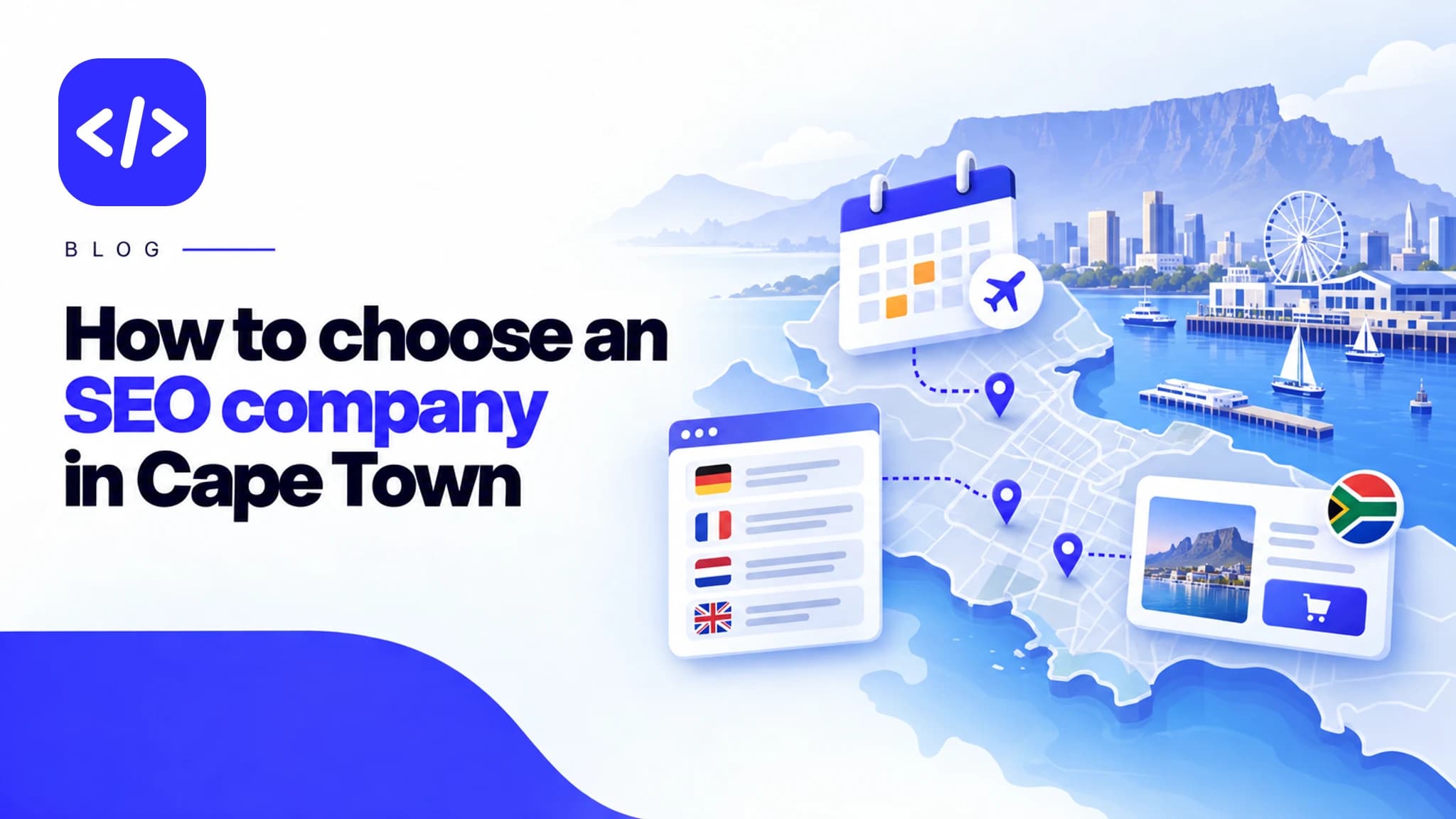
Answer up front: hire for seasonality, language and integrations
Hire an SEO partner in Cape Town that can (1) plan seasonal campaigns tied to monthly arrival patterns, (2) build targeted multilingual landing pages with correct hreflang and schema, and (3) connect the website to booking/payment systems and server‑side measurement so conversions aren’t lost in the hand‑off. These three capabilities together protect seasonal revenue peaks and capture international booking intent within measurable funnels.
Cape Town at a glance: months, arrivals and source markets
Cape Town shows clear monthly peaks you must plan around — use those months for major content drops and campaign support rather than an even, year‑round cadence. See the city’s arrival and occupancy trends in the Cape Town Tourism annual report for month‑level patterns and recovery metrics: Cape Town Tourism annual report.
Top overseas source markets that consistently produce bookings include the UK, USA, Germany, the Netherlands and France; use that list to prioritise which language pages to pilot first rather than translating everything by default — the Wesgro visitor trends report shows those market patterns and monthly behaviour: Wesgro visitor trends (Jan–Dec 2023).

Decide your priority: local footfall, international bookings, or both
Your product or offer determines the SEO brief, lead times and immediate tooling you need. Use this decision table to pick a primary track and set vendor acceptance criteria.
| Product / Offer | Primary SEO priority | Typical lead time | Immediate vendor requirement |
|---|---|---|---|
| Day tours, restaurants, city experiences | Local footfall & GBP (Google Business Profile) | Same‑day to 2 weeks | GBP management + local schema |
| Hotels, guesthouses, packaged tours | International bookings | 1–6 months | Seasonal landing pages + booking integration |
| Ecommerce retailers (gifts, local pickup) | Both (holiday spikes) | 2–6 weeks for promos | Seasonal landing pages + payment/fulfilment signals |
| Professional services (lawyers, consultants) | Local leads, selective international | Weeks–months | GBP + service pages targeting commercial queries |
Use vendor proposals to test the selected track: require a pilot that covers one peak month with paid support for international booking targets, or a GBP optimisation sample for local footfall.
Sector tactics: tourism, ecommerce and professional services
Tourism operators — capture intent by season and origin
- Map content to booking lead time: premium packages and long‑stay offers typically need landing pages and link campaigns 2–6 months before a peak month; last‑minute experiences use much shorter windows. Prioritise language pages where origin markets show booking volume (Wesgro data).
- Quick checklist:
- Programmatic landing‑page template for experience × season (Pilot parameter: 20 pages).
- One language funnel pilot (translate + booking flow).
- Structured data: Offer, Availability, Hotel or LocalBusiness schema.
- Booking → confirmation → analytics event flow test.
Pilot parameter — tourism mini‑case (timeline & KPIs):
- Scope: a Cape Town day‑tour operator builds 3 seasonal landing pages (summer, shoulder, winter) + one German landing page.
- Timeline: 6 weeks to build, 4 weeks to test with paid support in the target peak month.
- KPIs to track: organic landing‑page sessions, booking conversion rate, bookings attributed to organic (target: measurable uplift vs previous peak month).
Ecommerce retailers — design for Black Friday and festive spikes
South African online retail shows pronounced Black Friday and festive‑season spikes; treat these as fixed campaign windows and prepare landing pages, inventory signals and fulfilment messaging accordingly (see national online retail trend reporting): Peach Payments — Online Retail in South Africa 2024.
Key actions:
- Prepare inventory‑aware landing pages with clear delivery cut‑offs and local pickup options.
- Pre‑configure paid landing URLs and canonical tags for campaign scaling.
- Implement product availability and local‑pickup schema.
Pilot parameter — ecommerce mini‑case (timeline & KPIs):
- Scope: prepare 5 campaign landing pages ready for Black Friday + two local pickup pages.
- Timeline: 4 weeks to implement; 2 weeks of load testing and payment‑gateway validation.
- KPIs: cart‑abandonment rate, checkout completion rate, revenue per campaign, and delivery success within cut‑offs.
Professional services — prioritise local visibility and clear conversion paths
For lawyers, accountants and consultants, focus on local GBP optimisation and clear service pages. Use long‑form content that clarifies process and outcomes rather than generic practice descriptions. If pursuing international clients, create separate landing pages that explain cross‑border onboarding, pricing, and remote meeting availability.
Pilot parameter — professional services mini‑case:
- Scope: GBP cleanup + three service pages + one international onboarding landing page.
- Timeline: 3–6 weeks.
- KPIs: GBP views and calls, form submissions, and qualified consultations booked.
Multilingual choices and hreflang: which languages to add (and when)
Translate based on measurable booking intent, not goodwill. English dominates online, but German, Dutch and French visitors produce concentrated booking intent in specific segments; add language pages only when origin data shows transactions or clear demand (see university and industry studies on multilingual tourism behaviour): UWC multilingual tourism study. Hreflang helps prevent duplicate‑content confusion but is commonly misconfigured — follow a minimal checklist and consult practical guides: Peter Sawicki — hreflang for tourism multilingual websites.
Hreflang minimal checklist:
- Add reciprocal hreflang across all language versions.
- Provide an x‑default catch‑all for users without a preferred language.
- Align canonical tags to the correct language page.
- Use per‑language sitemaps or link headers for dynamic sites.
- Test with Google Search Console URL inspection and the hreflang testing tools.

Measurement, consent and POPIA: avoid losing conversion data
Consent flows and cookie limitations break attribution unless measurement is designed for it. Use first‑party or server‑side tagging to ensure booking events are captured even when third‑party cookies are restricted. For POPIA compliance, require vendors to document what personal data they collect, how consent is recorded, and where it is stored.
Server‑side tagging example (practical flow):
- Visitor lands on seasonal landing page (browser) → server assigns a first‑party session ID.
- Visitor accepts consent banner; client‑side tag fires and writes consent to a server cookie.
- Booking completed → booking system posts confirmation to server endpoint including session ID.
- Server‑side tag forwards event to analytics with persistent session mapping, even if client cookies are blocked.
Verification steps to insist on:
- A sample test booking that shows the session ID in the booking payload and the same session appearing in analytics.
- Log exports demonstrating the server received the booking and the analytics event mapping.
- A consent audit showing timestamped consent decisions stored with the booking record.
Vendor must show:
- Consent plan and event map (campaign → visit → booking).
- Server‑side tagging or first‑party measurement strategy.
- A booking confirmation → analytics event demo that traces back to the landing page.
Vendor checklist: 10 RFP questions, scoring rubric and scoping examples
Use the accordion below when you shortlist vendors; require sample deliverables to shorten selection time.
1. Do you have Cape Town or destination tourism experience?
2. How do you decide which languages to implement?
3. Can you build programmatic or template landing pages at scale?
4. What booking/payment systems have you integrated?
5. How will you handle measurement and POPIA consent?
6. Hreflang and canonical strategy
7. What success metrics and reporting cadence do you propose?
8. Can you show three technical samples (page template, hreflang header, analytics event)?
9. Pilot scope and pricing examples
10. References and SLAs
Scoring rubric (weights to apply when comparing proposals):
- Seasonal & market experience: 30%
- Multilingual & technical implementation: 25%
- Measurement & POPIA plan: 20%
- Integrations & sample deliverables: 15%
- Pricing transparency & SLAs: 10%
Sample 3‑month seasonal priority plan (compact)
| Month | Priority | Actions (example) |
|---|---|---|
| Nov (pre‑summer) | Content seeding & language pilots | Publish 3 summer landing pages, launch one German page, start paid retargeting for last‑minute stays. |
| Dec (peak) | Paid amplification & GBP promos | Boost best‑performing landing pages, publish local pickup ecommerce promos, GBP holiday hours + posts. |
| Jan (shoulder) | Measurement & optimisation | Run attribution QA, server‑side tagging verification, and scale programmatic pages that performed best. |
Next steps you can run this week
- Export 12 months of bookings/transactions and top landing pages; share them with shortlisted vendors and request a seasonal priority plan pilot for a peak month.
- Commission a 4‑week multilingual landing‑page pilot: one language, three pages, hreflang, booking test, and a measurement map. Treat the pilot parameters as the acceptance criteria.
- Ask each vendor for a measurement map and a POPIA‑compliant consent plan that shows how a booking is attributed when users change consent.
Luminum builds connected websites and customer operations—linking landing pages to booking/payment systems and measurable analytics—so a single partner can both build the experience and preserve attribution across channels. See how Luminum maps websites to customer journeys and integrations: Luminum solutions. For proposals shaped by outcomes, not software lists, see our approach: Luminum pricing approach.

