Lead generation agency Pretoria: route service leads better
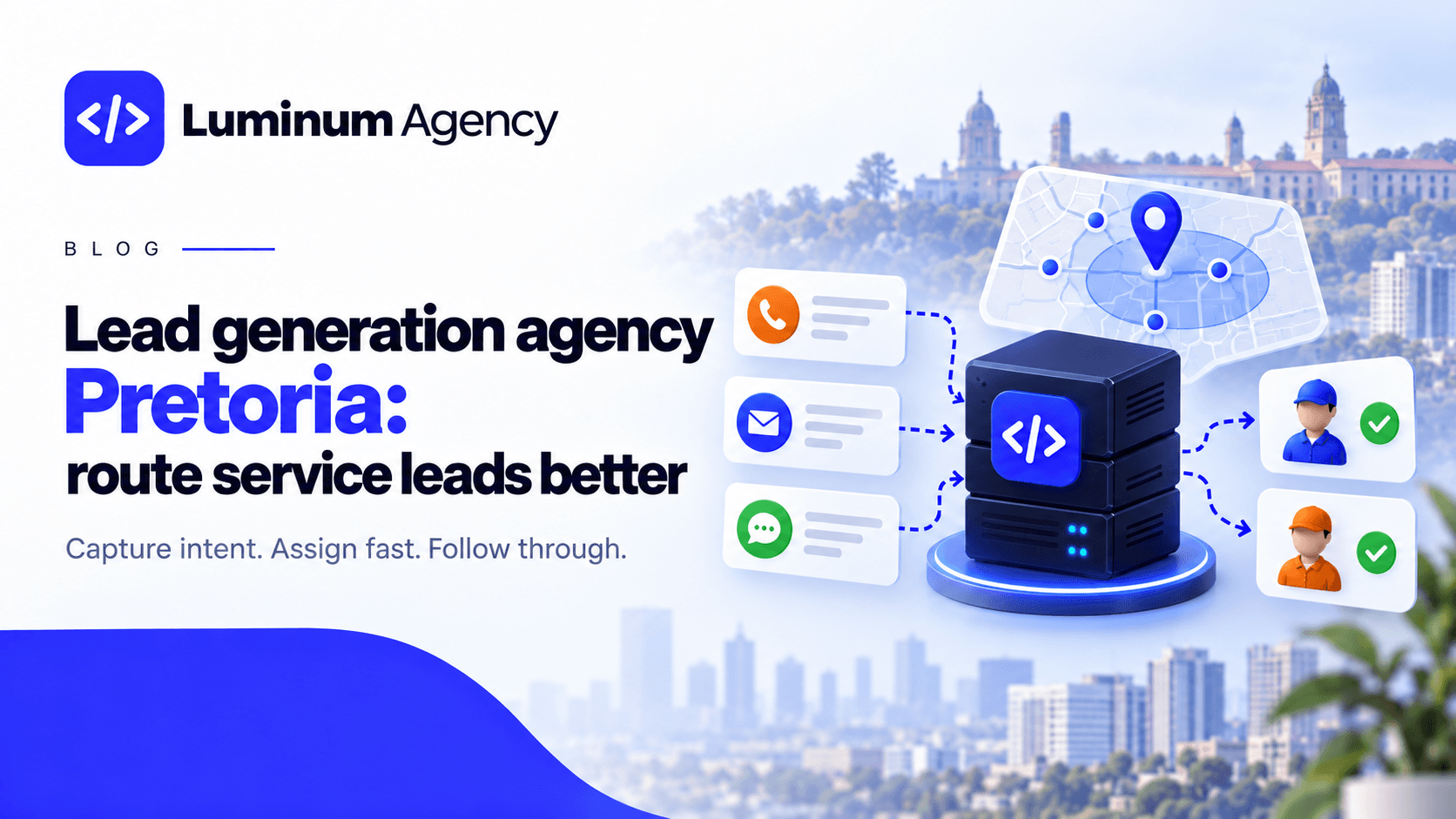
A lead generation agency in Pretoria should help a service business answer three operational questions: what does this person need, can we serve the location, and who must respond next? If the campaign stops at a form notification, the business is buying enquiries without building a dependable lead system.
Pretoria service demand is a routing problem
A service company may cover Pretoria East, Centurion, Montana, Hatfield and selected surrounding areas while using different teams, appointment calendars or travel rules. The landing page can attract a relevant enquiry and still fail commercially if it reaches the wrong person or waits in an inbox.
Map the path before increasing traffic:
- a person searches, clicks or arrives through a campaign;
- the page confirms service and location fit;
- the form, call or message captures enough intent;
- the CRM creates or matches the contact;
- a routing rule assigns an accountable owner;
- the owner attempts contact within the agreed window;
- the lead is qualified, booked, quoted, recycled or closed with a reason.
Every missing step creates waste that can be mistaken for a marketing problem.
Define serviceability as data
Do not leave service-area knowledge in one dispatcher’s head. Store the rules in fields the system can use.
| Routing input | Example use |
|---|---|
| Area or suburb | Match to the correct branch or mobile team |
| Service required | Assign a specialist rather than a general queue |
| Urgency | Prioritise same-day needs separately |
| Property or customer type | Match skills, equipment or commercial process |
| Preferred time | Route into a suitable appointment workflow |
| Existing customer | Preserve the account relationship |
Ask only what is needed for the next action. Use address lookup or a clear area choice where geography is decisive, but provide an “unsure” path so a valid buyer is not blocked by your internal structure.
Match landing pages to real operating zones
A useful local page explains more than a place name. It should clarify the service, meaningful coverage, response process, proof and limitations. Avoid dozens of near-identical suburb pages that add no local value.
Create a separate page when at least one of these is genuinely different:
- the service or team available;
- travel, delivery or appointment conditions;
- the customer problem and proof required;
- response time or booking process;
- local examples, regulations or frequently asked questions.
Keep campaign location settings under review as well. Google notes that location targeting uses multiple signals and is not perfectly accurate, so CRM area and fulfilment data should verify whether the campaign reaches serviceable customers (Google Ads location targeting).
Design one qualification contract
Marketing, dispatch and sales should use the same definition of a usable lead. Write it in one page.
A service-qualified lead may require:
- a currently offered service;
- a serviceable location;
- valid, reachable contact details;
- a real requirement rather than a job or supplier enquiry;
- consent and privacy handling appropriate to the channel;
- enough timing information to select the next step.
Then define explicit outcomes: booked, quoted, won, lost, duplicate, unreachable, unsupported service, outside area, spam or future follow-up. These outcomes turn vague complaints about lead quality into campaign feedback.
HubSpot's lifecycle guidance distinguishes stages such as lead, marketing-qualified lead, sales-qualified lead, opportunity and customer. A service business may use different names, but it needs the same shared understanding of movement through the process (HubSpot lifecycle stages).
Route to a person, not a shared inbox
Assignment rules should consider service, area, availability and existing relationships. Process the most specific rules first and keep a safe fallback owner for anything unmatched.
Salesforce describes assignment rules as ordered criteria that allocate leads to users or queues. The exact CRM can differ; the operational lesson is that every rule needs a defined destination and a final catch-all (Salesforce assignment-rule guidance).
Test at least these cases before launch:
- a valid lead for each service area;
- an area boundary;
- an unsupported service;
- an existing customer;
- an after-hours urgent enquiry;
- a duplicate submission;
- a lead with missing optional data;
- the fallback path when an owner is unavailable.
Record the assigned owner and timestamp in the CRM. A notification without ownership is not routing.
Make the response SLA visible
Define separate timers for assignment, first attempt and successful contact. The first automated acknowledgement should confirm receipt and set expectations; it should not be counted as human follow-up.
| Timer | Starts | Stops |
|---|---|---|
| Assignment | Enquiry captured | Named owner stored |
| First attempt | Enquiry captured | Human attempt logged |
| Contact | Enquiry captured | Two-way conversation recorded |
| Booking | Enquiry captured | Appointment or next step confirmed |
Set targets from staffing and customer urgency rather than copying an internet benchmark. Review performance by business hours, service and lead source. Escalate missed targets to another owner instead of silently leaving the lead open.
Connect calls and messages to the same record
Pretoria service buyers may switch from a page to a call or private message. Capture the campaign and page context before the channel changes, then create or match one CRM contact.
For calls, record connected or missed status, the service requested, location, qualification and outcome. Google Ads call reporting can provide details such as call time, received or missed status and call type, but the business should still decide whether the conversation was commercially useful (Google Ads call reporting).
For messaging, preserve the original campaign reference, ask only necessary questions and route the conversation to the same owner logic. Avoid creating separate records for the form, call and message from one customer.
Keep consent and privacy in the workflow
Lead routing moves personal information across systems and people. Document which data is collected, why it is needed, who can access it, how long it is retained and how marketing preferences are respected.
The Information Regulator's guidance discusses consent for unsolicited electronic direct marketing and describes consent as voluntary, specific and informed. Apply the guidance to the exact channel and relationship with advice from the responsible legal or privacy team (Information Regulator direct-marketing guidance).
Privacy evidence should travel with the lead: source, notice version, timestamp and preference where applicable. Do not treat it as a disconnected website setting.
Report the leaks in the system
A monthly agency report should show the funnel and the operational leaks:
| Layer | Useful measures |
|---|---|
| Acquisition | Spend, visits, search terms, location |
| Capture | Calls, forms, messages, valid-contact rate |
| Routing | Assigned rate, unmatched leads, reassignment |
| Response | First-attempt time, contact rate, missed SLA |
| Qualification | Service fit, area fit, disqualification reasons |
| Revenue path | Bookings, quotes, opportunities, wins |
Segment by service and area before drawing conclusions. A source with a higher raw lead cost may be more profitable if it produces better fit and faster bookings.
A four-week repair plan
Week 1: map and define
Document service areas, qualification, outcome reasons, current channels and owners. Reconcile duplicate contacts and missing source fields.
Week 2: build and test routing
Configure fields, assignment, fallback ownership, alerts and timers. Test normal, edge and after-hours cases.
Week 3: align pages and campaigns
Rewrite pages where the offer or coverage is unclear. Add location exclusions and negative keywords based on rejected leads.
Week 4: close the feedback loop
Review actual enquiries with the receiving team. Fix routing and response problems before increasing media spend.
Should each Pretoria suburb have its own landing page?
What if several teams can handle the same lead?
Can the agency manage our CRM routing?
Select the agency that can show the handoff
Ask a lead generation agency to demonstrate the full journey with a test record: campaign, page, captured intent, owner assignment, alert, response timestamp, qualification and report. If it can show only the ad and the form, the most important half of the system is missing.
Luminum's Lead Capture System connects structured enquiries, attribution evidence and CRM handoff so teams can see what happened after the click.

