Lead generation agency vs in-house: SA SME decision
Quick answer (first screen)
Hire an agency if you need measurable SQLs this quarter; build in‑house if you already have steady monthly lead volume; use a hybrid to test then transfer. Use one KPI only: time to first measurable pipeline — defined as the first CRM SQL with auditable consent (consent_ts) and an assigned rep. Run that as a 60–90 day pilot gate.
Why this decision matters for South African SMEs
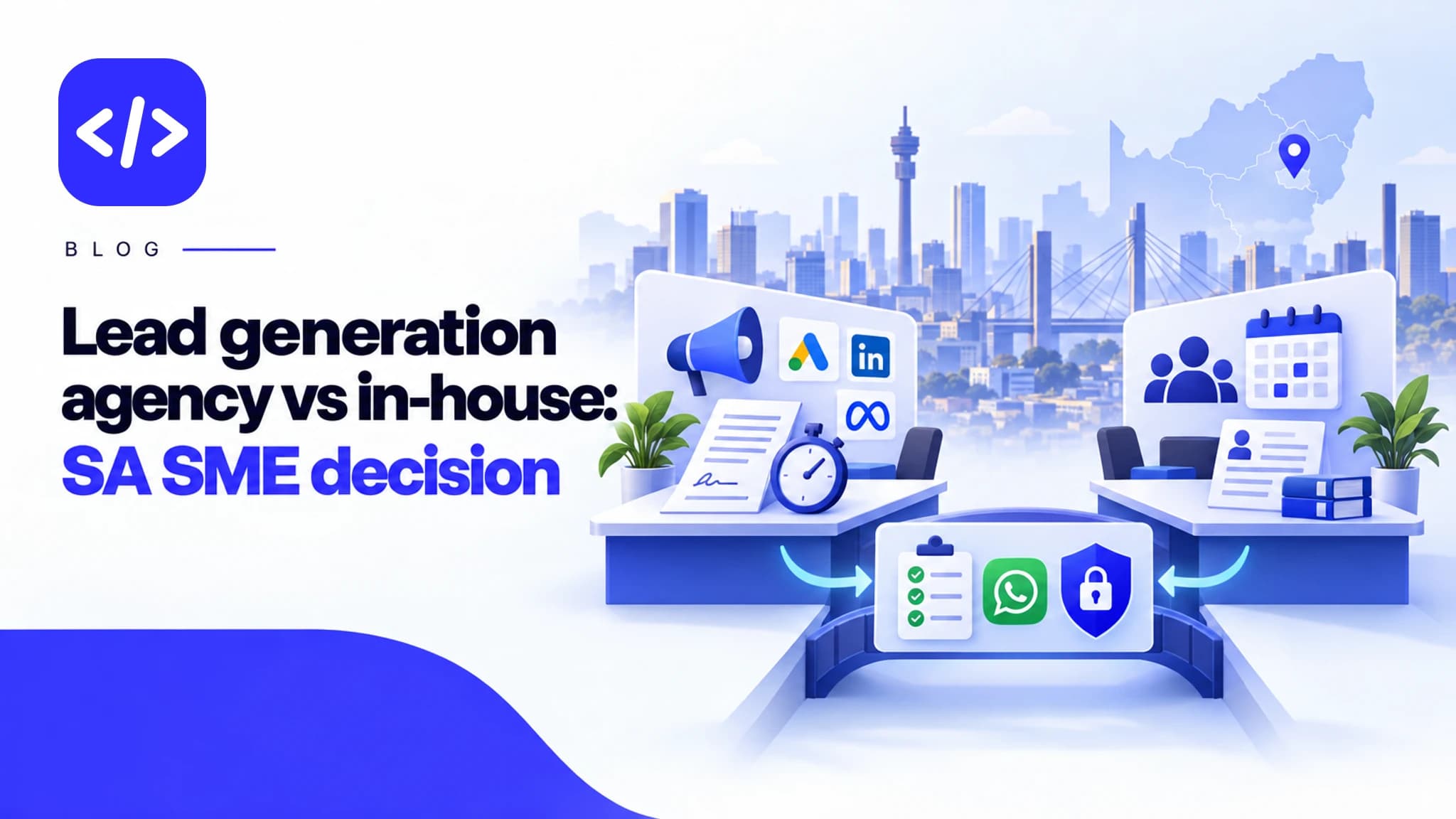
Three practical failure modes drive wrong choices: slow or missing responses to inbound enquiries, lead loss at handoff (especially via WhatsApp), and outreach that fails POPIA consent rules. These are not abstract — South African agency guides and compliance primers highlight handoff and consent as reasons pilots stall GrowthPulse local guidance. POPIA requires recorded, auditable consent for direct marketing; that changes how cold outreach and follow up must be implemented operationally Khanya POPIA guide.
Research shows speed-to-lead matters: faster contact materially increases contact and conversion rates, which is why SLA‑based pilots are a better test than vague promises InsideSales response time research and the Leads360 whitepaper on speed‑to‑call Leads360 speed‑to‑call whitepaper.
Decision matrix: pick agency, in‑house or hybrid
Use three axes to self‑select: time‑to‑pipeline, controllable unit economics, and POPIA‑safe handoff. Below is a compact guide for typical SA SMEs by objective.
- Agency — fastest time‑to‑pipeline. Choose this if you need measurable SQLs this quarter, lack the ops to enforce SLAs, or want an external team to buy delivery discipline quickly. Local guides show agencies often enable faster test outcomes and hybrid handovers later GrowthPulse local guidance.
- In‑house — greater long‑term control of unit economics and culture, but slower: hiring, training and ramping SDRs takes weeks. Best when you already receive steady leads monthly and have ops maturity.
- Hybrid — agency runs initial tests and builds the stack while you recruit and shadow; transfer when measurement gates are met.

Which path for your current monthly lead baseline:
- 0–10 leads/month: Agency or hybrid. You need speed and A/B testing to find channels; ops cost of an SDR is hard to justify until volume rises.
- 10–50 leads/month: Hybrid often wins. Use an agency to scale predictable channels and hire 0.5–1 FTE SDR to build long‑term control while learning the funnel.
- 50+ leads/month: In‑house becomes cost‑efficient. Invest in SDRs and ops to control unit economics and handoff quality.
Cost bands, time‑to‑value and a worked ROI example
Treat these as planning bands, not guarantees. Local pages and agency guides show similar ranges for South African SMEs BRBD practical costs GrowthPulse local guidance.
| Option | Typical monthly cost band (ZAR) | Pilot ramp to first measurable pipeline |
|---|---|---|
| Agency retainer + ad spend | R25k–R80k (retainer) + ad budgets | 0–8 weeks to first MQL; 8–12 weeks to an SQL pipeline (pilot parameter) |
| One SDR (salary + on‑costs) | R28k–R48k total on‑cost per month | 12–20 weeks ramp to consistent SQLs (hire & training) |
| Hybrid (agency test + 0.5 SDR) | Retainer R15k–R40k + SDR pro‑rata | 6–12 weeks to pipeline; transfer over 90 days |
Worked ROI example — hypothetical pilot parameters (illustrative only)
- Scenario (B2B): average deal R75,000; SQL→close 20% (i.e., 5 SQLs to close one sale). Pilot aim: 6 SQLs in 90 days.
- Agency route (pilot): retainer R40k + ad spend R30k = R70k/month → 3 months = R210k. If pilot produces 6 SQLs and maintains 20% close, expected 1.2 deals → revenue ≈ R90k. Payback in this short pilot is negative unless conversion or deal size improves.
- One SDR route: SDR on‑cost R35k/month = R105k over 3 months. SDR-driven CPLs are often lower but ramp risk is real; if SDR produces 6 SQLs in months 2–3, short‑term payback also looks thin.
- Hybrid route (recommended conservative test): retainer R20k + ad spend R15k + 0.5 SDR cost R18k/month = ~R53k/month → 3 months = R159k. Hybrid lowers upfront risk, builds internal capability, and provides a clearer handover if gates are met.
This example is intentionally conservative — treat CPL, SQL conversion and close rate as pilot inputs you will measure. Use this to size a pilot and decide whether the expected payback justifies proceed/transfer decisions.
Speed‑to‑lead SLAs and POPIA‑safe acknowledgements
Prescribe SLA pilot targets: an automated acknowledgement under 5 minutes and a human first touch under 60 minutes during business hours. These targets are rooted in lead‑response evidence showing faster contact improves conversion outcomes InsideSales response time research Leads360 speed‑to‑call whitepaper.
Practical acknowledgement copy (captures consent):
“Hi [Name], thanks for enquiring at [Business]. We received your request at [timestamp]. Reply Y to confirm we may contact you about this enquiry. — [Business name]”
Automation recipe (example)
- Flow: landing form → webhook → messaging API (WhatsApp/Email) → CRM create lead.
- Implementation notes: webhook sends payload to integration layer which triggers a sub‑60s automated acknowledgement via WhatsApp Business API or transactional email. The webhook must include a timestamp and consent snippet that the messaging copy references.
- Where to store consent_ts: map consent_ts to a CRM custom field as UTC ISO8601 (e.g., "2026‑10‑11T09:14:22Z"). Sample JSON payload the webhook should POST:
{
"contact_name":"Jane Doe",
"contact_phone":"+27 82 000 0000",
"lead_source":"landing_page",
"campaign_utm":"utm_source=linkedin&utm_campaign=offerX",
"consent_ts":"2026-10-11T09:14:22Z",
"consent_text":"User replied 'Y' to WhatsApp consent prompt"
}
CRM handoff: exact fields, SLA escalation and validation tests
A repeatable, auditable handoff stops lead leakage. Copy these fields into your form/webhook and CRM mapping (store consent_ts as UTC ISO8601):
- contact_name, contact_email, contact_phone
- lead_source (landing_page | linkedin | whatsapp | ad | referral)
- campaign_utm (utm_source | utm_medium | utm_campaign)
- consent_ts, consent_text
- initial_icp_score (0–100)
- qualification_flags (budget | decision | timeline)
- first_contact_attempt_ts, first_human_touch_ts, assigned_to
Simple ICP score formula (pilot): Fit (0–40) + Intent (0–40) + Engagement (0–20) → scale 0–100. Define sub‑scores before testing.
CRM field spec (copyable)
SLA escalation rules
Validation tests to run (4 quick checks)
These fields and tests are practical gates drawn from operational lead‑response playbooks and speed‑to‑call research; they make the SLA targets auditable and actionable Leads360 speed‑to‑call whitepaper. Map integrations from website → lead capture → CRM → messaging stack; a platform‑first integration reduces handoff gaps and simplifies audits Luminum solutions.

Recommended 90‑day hybrid roadmap (no‑nonsense)
Weeks 0–1: Agree measurement — KPI = time to first measurable pipeline (SQL with consent_ts and assigned rep); capture pilot CPL targets.
Weeks 1–4: Agency runs two paid channel tests, builds landing page + WhatsApp capture, wires CRM fields and SLAs, and documents transfer manuscripts.
Weeks 5–8: Agency shadows SDR/ops hire; run validation tests and tune messaging/flows. Recruit or upskill SDR.
Weeks 9–12: Evaluate gates — if SQLs are consistent, SLAs met and consent records clean, start formal handover; agency moves to advisory/QA.
Gates (examples — decide your X during scoping):
- Three consecutive weeks with ≥X SQLs (pilot X often 4–8; set it using your deal economics).
- SLA compliance ≥90% for automated ack and first human touch.
- Consent_ts present on ≥95% of records.
If the gates fail, stop the transfer and fix capture/handoff failures before scaling. This approach balances speed with operational ownership and lets you avoid sunk costs from early mis‑scoped hires.
Checklist: what to ask agencies and what to measure in‑house
Ask agencies:
- How will you capture consent and where is it stored? (Require consent_ts.)
- What SLA will you commit to for ack and first human touch? (Request <5‑minute ack, <60‑minute human as pilot targets.)
- How will leads be wired into our CRM with UTMs and qualification fields?
- What reporting proves pipeline (SQL → assigned rep → meeting booked)?
Measure in‑house:
- Raw lead → MQL → SQL timestamps (audit trail).
- Response timestamps (automated ack and first human touch).
- Consent proof and audit trail presence (consent_ts, consent_text).
- Channel CPL and SQL conversion rates.
- Pipeline payback (months to recover ad + retainer costs).
Start this week: run a 90‑day hybrid brief that defines pilot CPLs, SLA targets and the SQL gate; implement the CRM field list and run the four verification tests in the accordion; then schedule a 30‑minute diagnostic to map website → capture → CRM flows if you'd like external help Luminum contact.

