Hiring a website developer: eight mistakes to avoid before you sign

In this article
- 1. Comparing quotes with different scopes
- 2. Leaving account control until handover
- 3. Approving screenshots instead of customer journeys
- 4. Assuming the developer writes the content
- 5. Forgetting the old website
- 6. Accepting vague support promises
- 7. Paying against dates without acceptance criteria
- 8. Buying guarantees the supplier cannot control
- Try this before the next supplier meeting
- Related reading
The expensive mistake is not always hiring the cheapest developer. It is buying a project that nobody has defined. A good-looking proposal can still leave the copy, hosting, migration and maintenance in the space between “included” and “we assumed you would do that”.
1. Comparing quotes with different scopes
Give each supplier the same brief. List required pages, functions, integrations, content responsibilities and existing-site migration. Ask for exclusions and recurring costs. A setup-only quote is not comparable with a year of hosting and support.
2. Leaving account control until handover
Agree who registers the domain, controls hosting and administers essential services. The business should retain appropriate access and understand how to transfer or recover accounts. Use individual access roles rather than a shared password passed between staff.
3. Approving screenshots instead of customer journeys
A portfolio shows visual ability, not necessarily reliable delivery. Inspect a relevant live example on your phone. For your own project, test finding a service, submitting an enquiry and receiving a response. If you need a booking or payment system, test its failure cases too.
| Compare | Ask for | Why it matters |
|---|---|---|
| Scope | Pages, functions, content and exclusions | Prevents assumptions becoming extras |
| Control | Account and asset ownership details | Makes recovery and handover possible |
| Acceptance | Real tests for important journeys | Checks more than appearance |
| Support | Responsibilities and escalation process | Keeps the site usable after launch |
4. Assuming the developer writes the content
Decide who supplies facts, writes copy, checks claims and approves images. “Five pages” says nothing about who creates them. Provide accurate service details early; a designer cannot responsibly invent your credentials, prices or customer results.
5. Forgetting the old website
If the project replaces an existing site, inventory valuable pages and customer routes. Agree what remains, moves or is retired, then test redirects and indexability after launch. Do not approve a migration solely because the home page looks correct.
6. Accepting vague support promises
Ask what support includes, how to report an incident, what is monitored and how restoration works. Clarify response expectations and additional charges. “We are always here” is less useful than a documented process with an accountable contact.
7. Paying against dates without acceptance criteria
Milestones should describe completed work and how it is checked. A design approval, functional demonstration and tested handover are different stages. Discuss payment terms and change control before work starts; seek professional advice where contractual risk warrants it.
8. Buying guarantees the supplier cannot control
A developer can commit to agreed functionality and testing. Customer demand, search rankings and revenue depend on more than the build. Ask what a performance claim actually measures, over what period and under which conditions.
Try this before the next supplier meeting
Write three sentences: “The visitor needs to…”, “Our staff need to…”, and “We will accept the site when…”. For an illustrative service business, those could be finding a suitable service, receiving an assigned enquiry and completing a successful mobile test. The exercise turns a vague project into something both parties can discuss.
Luminum provides web services. Apply these checks to our scope as well as anyone else's; the purpose is a better agreement, not an unsupported provider ranking.
Put the guide into practice
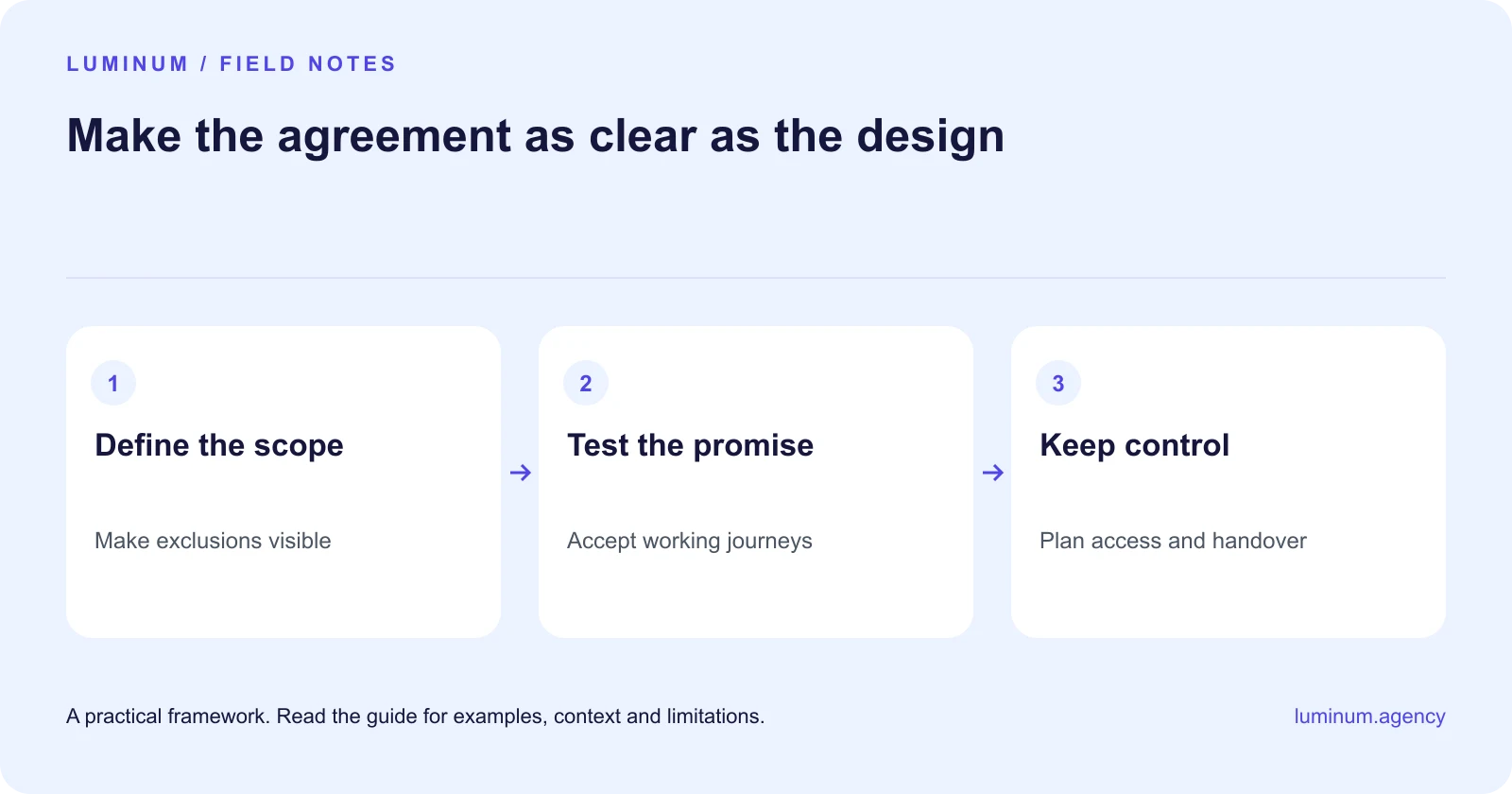
Step 1
Define the scope
Make exclusions visible
Step 2
Test the promise
Accept working journeys
Step 3
Keep control
Plan access and handover
Related reading
- Website developers near you in Pretoria: how to shortlist the right fit
- Website redesign SEO checklist: protect rankings during migration
Substantively updated in October 2026. Examples identified as illustrative are not client results.

