How to get your first business website in South Africa

In this article
You do not need to understand every website technology to make a good first decision. You need to know what the site should help a customer do, who will keep it accurate and what you are agreeing to buy.
1. Define the purpose
Choose the primary task: request a quote, book a service, buy a product or review your work. Write down what someone must know before taking that action. This prevents the project becoming a collection of features with no clear job.
Keep a list of later ideas. A business can begin with a useful service site and add a shop when it has products, fulfilment and support ready. Launching everything at once can create work the team cannot maintain.
2. Register and control the domain
Choose a clear name and check renewal terms. Make sure the business understands who is the registrant, who can manage the account and how recovery works. Record renewal dates and use secure access arrangements.
Domain registration, website hosting and business email are separate services even when sold together. Ask what each fee covers and what happens if you move suppliers.
3. Choose a platform around your needs
A website builder can suit straightforward editing needs. A CMS can support structured content and a broader publishing workflow. Custom development may be appropriate for a requirement standard tools cannot reasonably meet. There is no universal winner.
Try the editing experience before committing. Ask about exports, recurring licences, backups and who maintains integrations. The person updating the site after launch deserves a say in the choice.
| Compare | Your decision | Keep a record of |
|---|---|---|
| Purpose | What should the customer do? | Primary journey and required information |
| Platform | Who will maintain it? | Limits, licences and export options |
| Content | Who approves the facts? | Permissions and source material |
| Handover | Who owns operation? | Accounts, renewals and support |
4. Prepare accurate content
Gather services, contact details, coverage, prices or cost factors, and genuine proof of work. Use images you have permission to publish. Label stock or illustrative material honestly instead of implying it shows your team or premises.
Write for the customer, not the company presentation. Explain what happens after an enquiry and what information helps you respond. Have the appropriate person review legal terms, credentials and other consequential claims.
5. Build and test the essential journey
Test on a phone and with a keyboard. Check links, forms, confirmation messages and the record received by staff. For a shop, test the supported payment and order scenarios, including failures and refunds. Use test environments and fictional data where available.
Make sure someone can correct everyday information without breaking the layout. Record known limitations before sign-off rather than discovering them during a customer call.
6. Launch with ownership, not just a link
Keep a handover record of accounts, renewal dates, support contacts and responsibilities. If replacing an older site, include URL mapping and migration checks. Verify the public pages and important functions after launch.
7. Bring the right people to the site
A published website does not create demand automatically. Choose appropriate ways to reach your audience—useful search content, legitimate local presence, existing customer communication or a measured advertising test. Do not buy every marketing channel immediately.
Review real enquiries and customer questions. Improve the unclear or broken parts first. Your first website should be a useful foundation you can maintain, not a permanent commitment to every feature proposed at the first meeting.
Put the guide into practice
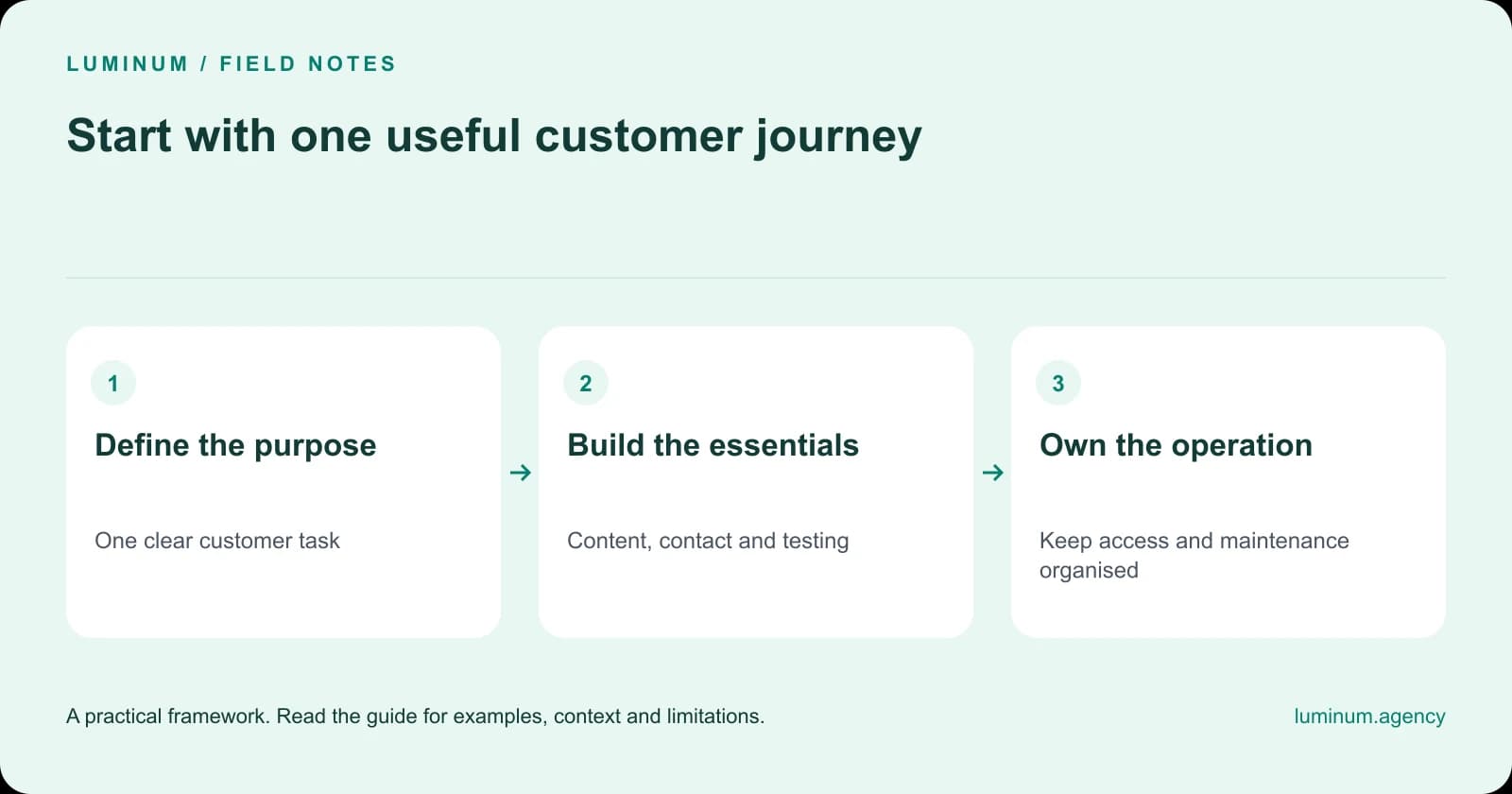
Step 1
Define the purpose
One clear customer task
Step 2
Build the essentials
Content, contact and testing
Step 3
Own the operation
Keep access and maintenance organised
Related reading
- Your first small-business website in Pretoria: what to prepare
- How much does a website cost in Pretoria? Compare the whole commitment
Substantively updated in October 2026. Examples identified as illustrative are not client results.

