Your website gets no customers? Diagnose the missing step

In this article
“We need more leads” is a conclusion, not a diagnosis. A site with almost no relevant visitors has a different problem from one whose contact form silently fails. Work through the journey in order before buying more traffic or commissioning a redesign.
First: are the right people arriving?
Check which pages and queries attract visits, where appropriate data is available. Separate branded searches from people discovering the business for the first time. Look for relevance: a busy article about an unrelated topic may contribute little to the service you want to sell.
If the sample is tiny, do not draw confident conclusions about conversion rates. Confirm that measurement is working and that the pages can be found before declaring the design a failure.
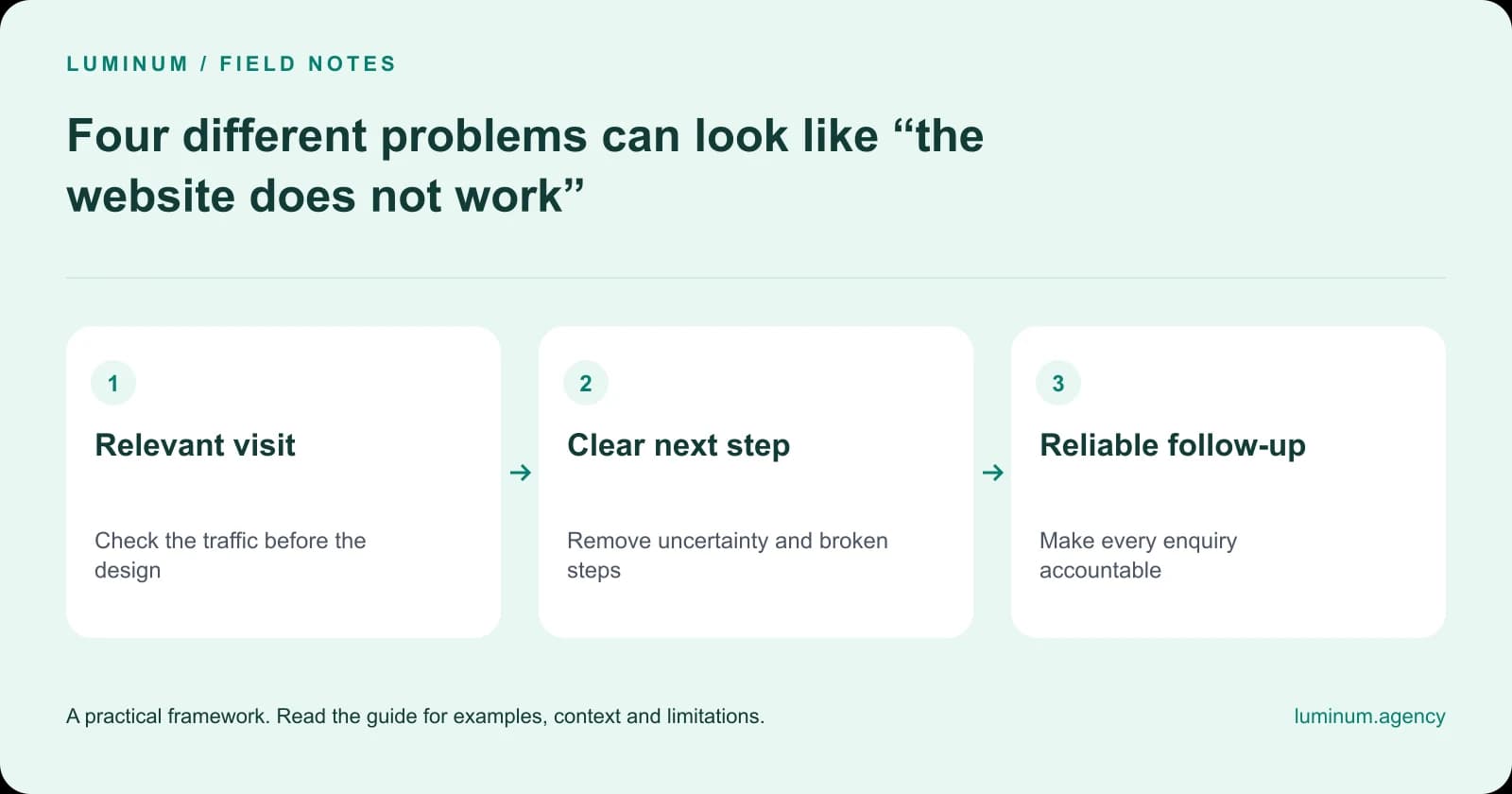
Second: can a visitor understand the offer?
Read the first screen without relying on your knowledge of the business. Does it explain what is offered, who it suits and where it is available? “Innovative solutions for your success” could describe almost anything.
For an illustrative repair business, “Book an assessment for commercial refrigeration in our listed service areas” tells a visitor more than “Experience excellence”. Follow with the practical details: exclusions, availability, relevant proof and the next step.
Third: does the contact journey work?
Test every important route on a phone: form, call link, email link and messaging link. Submit a genuine test record and check both the customer confirmation and the staff notification. Try an invalid field and a slow connection.
Ask only for information needed at that stage. Explain why a sensitive or unusual field is necessary. A quote request does not always need a full postal address, company size and marketing questionnaire before a conversation can begin.
| Compare | Evidence | First action |
|---|---|---|
| Are suitable visitors arriving? | Relevant queries and landing pages | Improve discoverability or targeting |
| Do they understand the offer? | User feedback and page review | Clarify the service and proof |
| Can they contact you? | Successful end-to-end tests | Repair the contact journey |
| Does the business follow up? | Owner, response and outcome records | Fix the handoff |
Fourth: does somebody respond?
A working website can deliver an enquiry into a broken process. Check missed calls, unassigned records, response coverage and the promises made in confirmation messages. If the site says “we will contact you today”, someone needs to own that promise.
Review lost enquiries with the team. Distinguish poor fit, unavailable capacity, unanswered contact and a customer choosing another provider. Those reasons call for different improvements.
Run one meaningful test
Choose the clearest obstacle and make a focused change. If the service is unclear, improve the explanation. If the form is broken, repair it. If the response queue is unattended, fix ownership. Record when the change went live and what you will examine next.
Avoid changing the offer, traffic source, page and follow-up process simultaneously if you want to understand what helped. In low-volume businesses, qualitative feedback and verified operational fixes may be more useful than a formal split test.

Know when a redesign is justified
A redesign can be appropriate when the structure prevents useful improvements or the experience is consistently difficult to maintain. It is not the automatic answer to every quiet inbox. Ask for evidence of the constraint and a plan that preserves valuable content and URLs.
Related reading
- A professional business website: the anatomy of a useful service page
- Lead generation agency Pretoria: route service leads better
Substantively updated in October 2026. Examples identified as illustrative are not client results.

